
Why Are Packages Taking Longer to Arrive During the Holiday Shipping Season?
Packages take longer to arrive during the holidays mainly because carriers are handling far more volume than usual at the same time that retailers, fulfillment centers, and delivery trucks are all running closer to their limits, so the same package that would normally move in two or three days can realistically take a week or more. Holiday shipping delays are not usually a sign that something has gone wrong with your specific order; they are largely a predictable, seasonal side effect of nearly every online shopper in the country ordering gifts in the same six-week window. Understanding why this happens, and when carriers expect it to happen, is the best way to plan your own orders so a gift does not arrive after the holiday it was meant for.
How Much More Volume Are Carriers Actually Handling?
The scale of holiday shopping is larger than most people realize until they see the numbers side by side. According to the National Retail Federation, an estimated 202.9 million consumers shopped over the five day stretch from Thanksgiving Day through Cyber Monday in 2025, the largest turnout since NRF began tracking that period, with 85.7 million shopping online on Black Friday alone and another 75.9 million shopping online on Cyber Monday. NRF also reported that holiday season retail sales surpassed one trillion dollars for the first time, with shoppers budgeting an average of 890 dollars each on gifts and other seasonal purchases, and that by early December the average shopper had completed only about 51 percent of their holiday shopping, meaning the other half was still moving through carrier networks in the final weeks before Christmas.
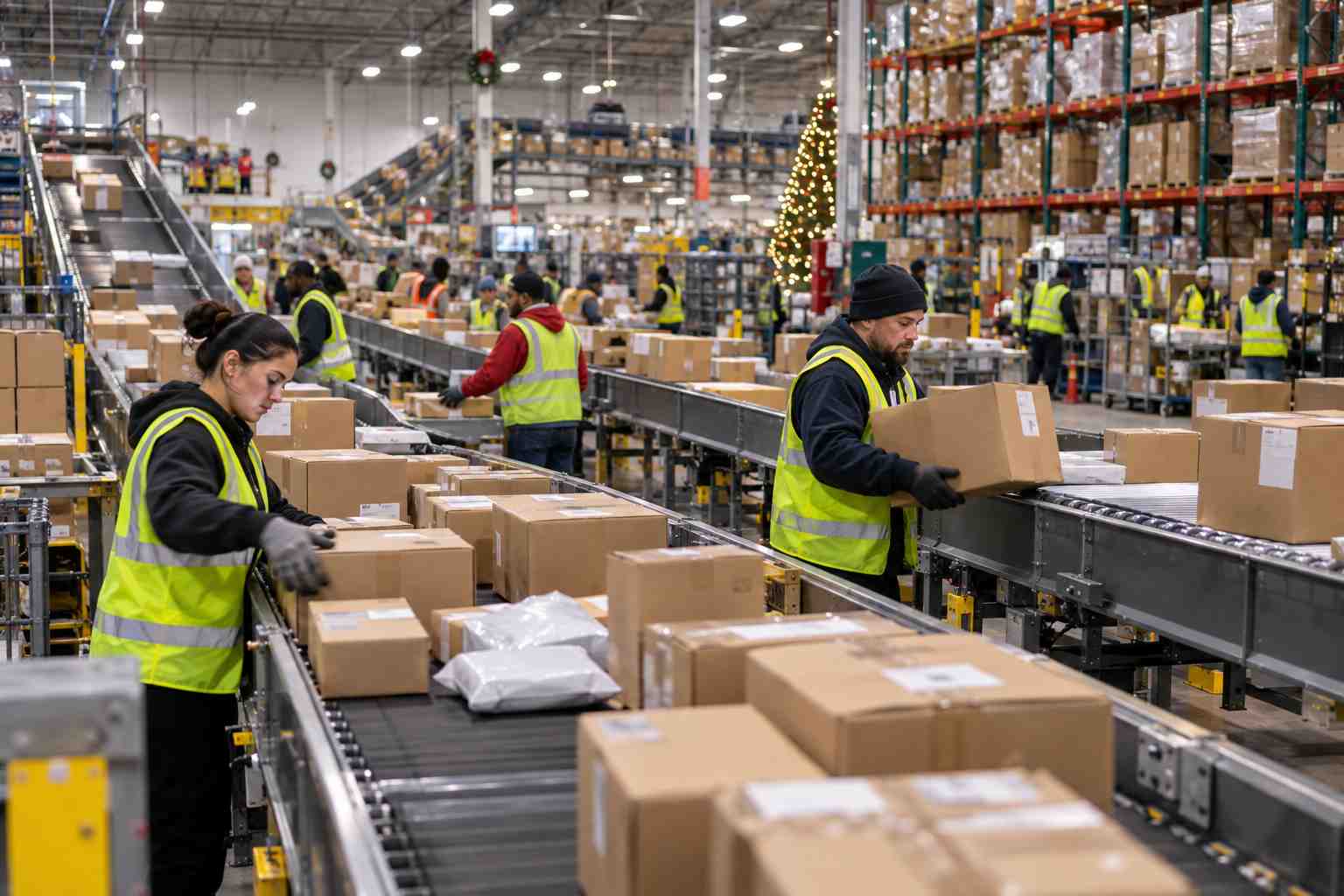
Picture a regional distribution center that comfortably sorts 40,000 packages on a typical Tuesday in October. During the week of Black Friday and Cyber Monday, that same facility might see two or three times that volume arrive at once, using the same building, the same sorting equipment, and largely the same staff. Delivery trucks that normally run a route with room to spare are loaded to capacity, drivers are working longer days, and a single sorting delay at one facility can ripple forward into every package scheduled to move through it that day. None of this means a carrier is doing a bad job; it means the entire system is absorbing a temporary but very real surge, and transit times stretch as a direct result.
Why Carriers Set Earlier “Order By” Deadlines Each Year
This is also exactly why USPS, UPS, and FedEx each publish a shipping cutoff calendar every year with specific “order by” or “ship by” dates for guaranteed delivery before Christmas. Looking at last year’s published deadlines helps illustrate the pattern, since the exact dates shift by a day or two from year to year but the underlying logic stays the same. For the 2025 season, USPS set December 17 as the cutoff for Ground Advantage and First Class Mail, December 18 for Priority Mail, and December 20 for Priority Mail Express. FedEx set December 15 for FedEx Ground Economy, December 20 for Express Saver, December 22 for 2Day service, and December 23 for its overnight tiers. UPS set December 19 for 3 Day Select, December 22 for 2nd Day Air, and December 23 for Next Day Air.
Notice the pattern: the slowest, least expensive services have the earliest cutoffs, while the fastest, most expensive overnight services keep working almost right up to the holiday itself. That is because economy and ground services have the least amount of built in buffer left once holiday volume slows the network down, while overnight service is priced specifically to guarantee a carrier can still clear space for it even during the busiest week of the year. If you are ordering a gift using standard or economy shipping, you are effectively borrowing against a smaller cushion of extra time than someone paying for expedited shipping, which is why standard shipping is the first service level to feel the effects of a holiday slowdown.
Weather, Fuel Surcharges, and Other Seasonal Wildcards
Volume is not the only factor stacking up against a fast delivery in November and December. Winter weather across large parts of the country adds regional slowdowns on top of the network wide volume increase, since a single snowstorm or ice event at a major hub can delay every package scheduled to move through it that day, even packages headed somewhere with clear skies. Carriers also apply seasonal peak surcharges during the busiest weeks of the year, which does not directly change how fast your package moves but does reflect the added cost of running extra trucks, extra staff, and extra sorting capacity to keep up with demand. A package that would sail through a distribution center in July might sit for an extra day in December simply because a winter storm two states away backed up the regional hub it needed to pass through first.
Retailers add their own layer of seasonal pressure as well. A popular item that sells out and gets restocked mid December often ships from a fulfillment center that is already working through a large backlog of holiday orders, which means the time between when you place an order and when it actually leaves the warehouse, not just the carrier’s transit time, can stretch out during peak weeks. This is one reason a package can show little or no tracking movement for a day or two right after you order it in December, even though the same order might have shipped the same day back in September.
Do All Carriers Slow Down by the Same Amount?
Not exactly, and the difference comes down to how each carrier’s network is built. USPS relies heavily on its own mail carriers making residential stops that already include first class letters and mail alongside packages, so a volume surge adds packages to a route that a carrier is walking or driving anyway, which can soften the impact somewhat compared to a pure parcel network. UPS and FedEx run networks built specifically around package volume and driver routes calculated by stop count and weight, so when the number of stops per route climbs sharply during peak weeks, drivers can run out of daylight before finishing a route that would normally wrap up hours earlier. Amazon’s own delivery network, which now handles a large share of Amazon orders directly rather than handing them to USPS or UPS, faces the same volume pressure as everyone else, and packages moving through it can show the same kind of holiday slowdown even though the tracking page looks a little different from a traditional carrier’s.
This is also why a single order with multiple items can arrive as separate shipments moving at different speeds during the holidays. A retailer might ship the in stock item from a nearby warehouse using a fast regional carrier partner, while a second item that had to come from a more distant fulfillment center rides in a standard USPS or UPS lane the entire way. Neither shipment is doing anything wrong; they are simply taking different paths through networks that are all under the same seasonal strain at once.
What This Means for When You Should Order
The most reliable way to avoid a late holiday delivery is to order earlier than you think you need to, ideally well before the published carrier cutoff dates rather than right up against them, since those dates represent the last possible day for a guaranteed delivery, not a comfortable safety margin. If a retailer’s own promised ship date is close to a carrier’s cutoff, remember that the carrier’s countdown only starts once the package is actually in their hands, not the moment you place the order, so a slow warehouse can eat into the buffer you were counting on. Choosing a faster shipping tier for anything time sensitive, and keeping an eye on the tracking number once it is issued, gives you the earliest possible warning if a package is falling behind schedule.
It also helps to think in terms of business days rather than calendar days when the holidays are involved. A “3 to 5 business day” estimate given in early December can easily land on or after a weekend that includes a carrier’s own modified holiday hours, effectively adding an extra day or two beyond what the same estimate would mean in a normal month. Building in that extra cushion, especially for a gift tied to a specific date, is a simple habit that avoids most last minute holiday shipping disappointments.
What to Do If Your Order Still Doesn’t Arrive in Time
Even with early ordering, some packages still run into a genuine delay during peak season, whether from a weather event, a sorting backlog, or a lost scan. If a package’s tracking has not updated in several days during the holidays, it is often still moving through a congested facility rather than truly lost, so it is worth waiting a bit longer than you would during a normal month before assuming the worst. If it does become clear that a gift will not arrive in time, most retailers and carriers have specific holiday policies for expedited replacements or refunds, and checking those policies as soon as a delay looks likely gives you more options than waiting until the last minute.
On a side note, if you manage inbound deliveries for a mailroom, apartment community, or business receiving area, the holiday surge does not stop at your front door, it often creates the same kind of volume crunch inside your building that carriers see on the road, and having a clean, logged record of every package that comes in is exactly what mailroom automation software is designed to provide.
