
What Effective Proof of Delivery Records Need to Capture for Mailroom and Receiving Teams
A proof of delivery record that actually holds up in a dispute needs more than a signature. It needs a timestamp, the identity of who accepted the item, and ideally a photo or scan confirmation tied directly to a specific package, all captured automatically at the moment of handoff rather than reconstructed later from memory or a paper log. When a “we never got that package” dispute comes up weeks after the fact, the strength of the record you already have on file determines how quickly and confidently it gets resolved.
Why “We Never Received It” Disputes Happen So Often
In any receiving operation handling packages for multiple people, whether that is a corporate mailroom, a university, or a multi-tenant building, disputes over whether an item was actually delivered are a routine part of the job, not an occasional edge case. A resident or employee genuinely may not remember picking something up weeks earlier. A signature on a clipboard can be illegible or belong to someone other than the actual recipient. A shared sign-in sheet can go missing entirely. None of these situations necessarily mean anything went wrong with the delivery itself, but without a solid record, resolving the dispute becomes a matter of he-said-she-said rather than a quick check against documented evidence.
The global market for proof of delivery software was valued at roughly $2.1 billion in 2024 and is projected to reach $5.8 billion by 2033, according to the Global Proof of Delivery Software Market Outlook, growth driven largely by exactly this problem: organizations that handle enough deliveries eventually need a documented, defensible answer to “are you sure it was delivered,” and a paper log or verbal confirmation increasingly does not hold up well enough on its own.
What a Strong Proof of Delivery Record Actually Includes
Not all proof of delivery is created equal. A few specific pieces of information turn a vague delivery log into something that can actually resolve a dispute with confidence:
- A timestamp tied to the specific package. Knowing that packages were received “sometime that afternoon” is far weaker than an exact time attached to a specific tracking number or package ID.
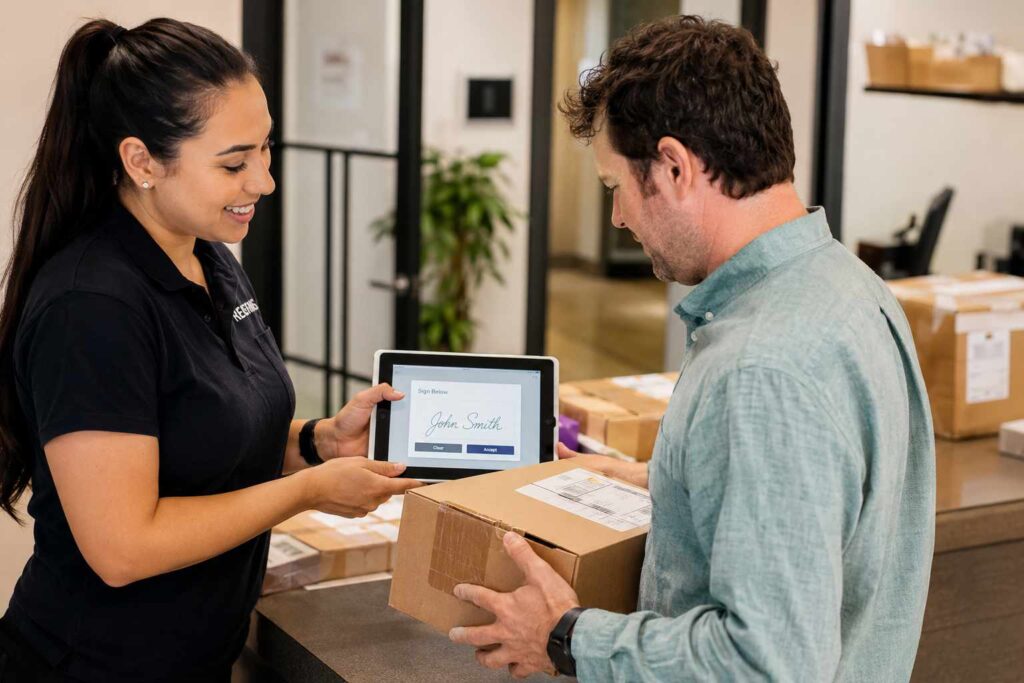
- Identity of the person who accepted it. A signature, a PIN code entry, or a QR code scan tied to a specific resident or employee record establishes who actually took possession, not just that something was handed off to someone.
- A photo of the package at handoff. A timestamped photo showing the package’s condition and, where relevant, who accepted it, is considerably harder to dispute than a signature alone, since it documents the physical state of the item at that exact moment.
- A record of where it was stored in between. For packages that sit in a mailroom or parcel area for a period before pickup, logging the shelf, locker, or location it was held in closes the gap between intake and final pickup, which is often exactly where a dispute lands.
Together, these pieces establish a complete chain from intake to final pickup, rather than a single data point that only covers one moment in that chain.
How This Plays Out in a Real Dispute
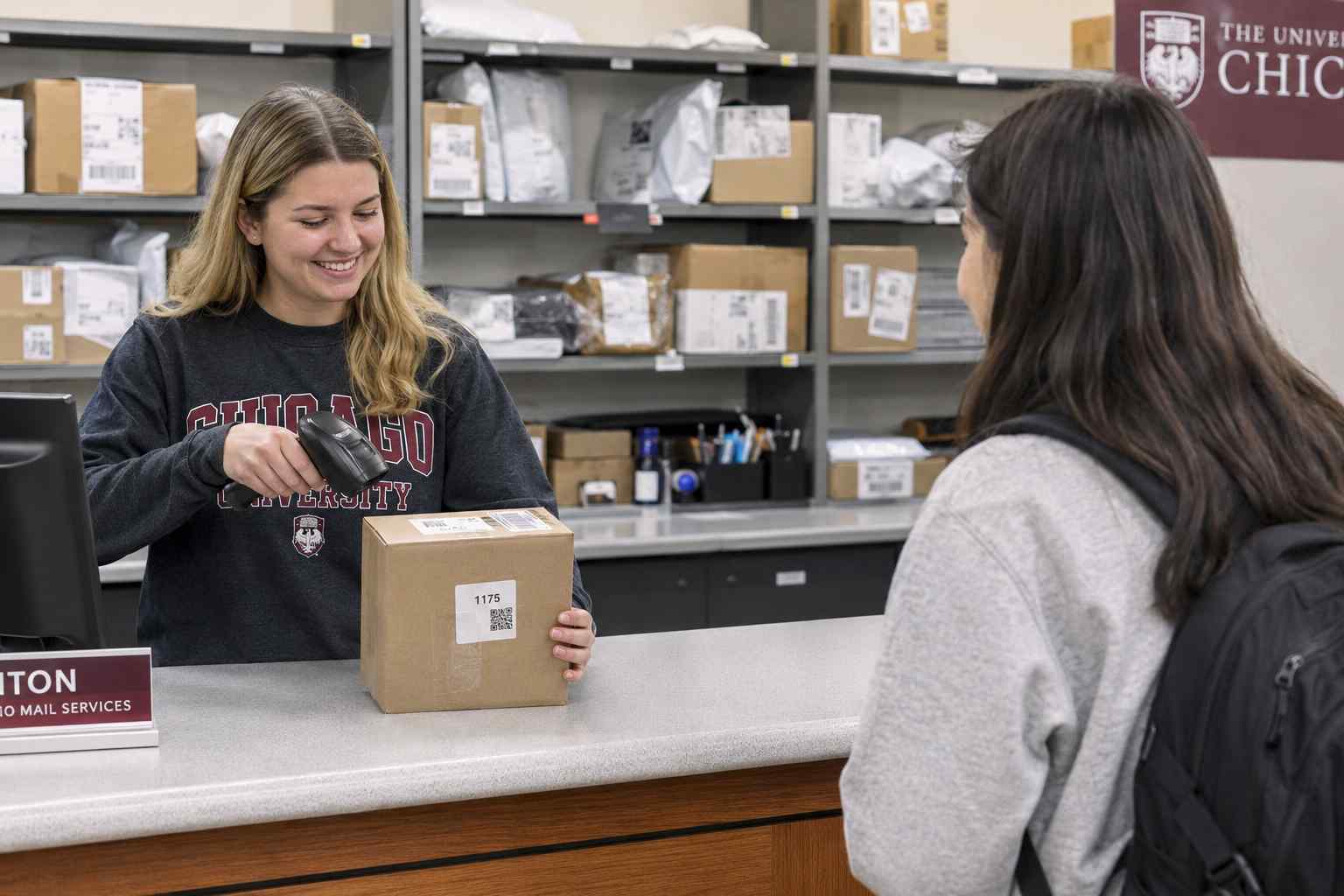
Consider a university mailroom that receives several hundred packages a day during a busy week. A student contacts the mailroom three weeks later insisting a package was never received, only to learn it shows as picked up in the system. Without a strong record, the mailroom staff has little to work with beyond a name on a log sheet, which the student may not remember signing weeks earlier. With a complete record, staff can pull up the exact timestamp, the QR code scan tied to that student’s ID, and, if the system captures it, a photo from the pickup counter showing the exchange. That combination typically resolves the question within minutes rather than becoming a drawn-out back and forth, and it protects the mailroom’s credibility in situations where the dispute turns out to be a genuine mistake on the student’s end rather than an actual delivery failure.
The same pattern plays out in a corporate setting, just with different stakes. An employee might claim a package containing company equipment, such as a laptop or a signed contract, was never delivered to their desk, when in fact it was accepted by a coworker on their behalf during an absence. A record that only logs “delivered to department” without capturing who physically accepted it leaves that question unresolved. A record that captures the actual name and timestamp of the person who signed for it settles the question immediately, and can matter considerably more than a missing package from an online order when the contents involve company property or a legal document.
Where This Fits Into a Broader Chain of Custody
Proof of delivery is really just the final link in a longer chain that starts the moment a package physically arrives at a facility. A record that only captures the very last handoff, while ignoring intake, storage, and any internal transfers between departments or floors, leaves gaps exactly where disputes tend to concentrate. Pairing strong proof of delivery capture with a documented chain of custody from the moment a package enters the building means every stage, not just the final pickup, has a timestamped record behind it. For organizations that face regulatory scrutiny or legal discovery around received items, such as healthcare facilities or research institutions, that complete chain matters even more, since a gap at any single stage can undermine the credibility of the entire record.
A Concrete Example From a Regulated Environment
The stakes go up considerably in settings where received items are tied to compliance requirements. A hospital receiving department, for instance, may take in specialty pharmaceuticals, lab specimens, or medical devices that require a documented, unbroken chain of custody from intake to the department that ultimately receives them. If a shipment’s status is ever questioned, whether for an internal audit, an insurance question, or a regulatory review, having an automatic, timestamped, photo-backed record for every handoff along the way is the difference between answering the question in minutes and having to reconstruct events from memory across multiple staff members who may not even recall the specific delivery. The same logic applies, at a smaller scale, to any organization that occasionally needs to prove exactly when and to whom something was handed off.
What to Look For When Evaluating a System
A few practical questions help separate a system that will genuinely hold up under scrutiny from one that only looks thorough on paper. Does the signature or scan get tied automatically to a specific package record, or does it live in a separate log that has to be manually cross-referenced later. Can photos be captured directly within the same workflow, without requiring staff to use a separate camera or app. Is the data retained long enough to cover the realistic window in which a dispute might come up, which for many organizations is well beyond 30 days. And can a specific record be pulled up quickly by package ID, recipient name, or date, rather than requiring someone to scroll through a long unindexed list.
It is also worth confirming how the system handles exceptions, such as a recipient who refuses a delivery, a package accepted by someone other than the intended recipient on their behalf, or an item that has to be returned to the carrier. A system that only has a clean workflow for the straightforward case and no clear way to document these less common situations will leave staff falling back on ad hoc notes exactly when a clear record matters most.
Getting Started
For a receiving operation still relying on a paper sign-in sheet or a signature captured with no other supporting detail, moving to a system that automatically timestamps, photographs, and indexes every handoff is usually a lower lift than it sounds, since it typically piggybacks on the same intake scanning step already in place. If dispute resolution currently depends on staff memory or a hard-to-search log, it is worth a closer look at what a documented proof of delivery workflow would change. You can get a quote to see what that would look like for your specific volume and setup.
Frequently Asked Questions
Is a signature alone enough to count as proof of delivery? It can help, but on its own a signature is often illegible or hard to tie to a specific person and time. Pairing it with a timestamp and, ideally, a photo creates a much stronger record.
How long should proof of delivery records be kept? This depends on the organization, but many disputes surface weeks after the fact, so retention windows shorter than 60 to 90 days can leave gaps in exactly the situations where the record is needed most.
Does proof of delivery only matter for the final handoff to the recipient? No. The strongest records document the full chain, intake, storage, and final pickup, since a gap at any one of those stages can weaken the overall case in a dispute.
