
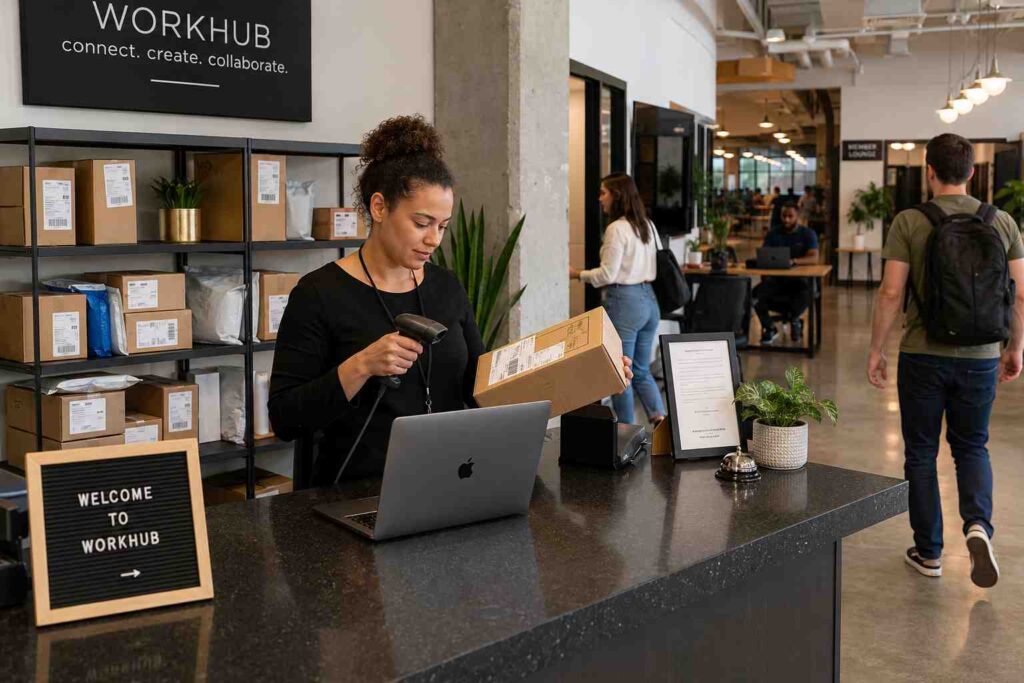
How Package Tracking Software Solves Mail and Package Management for Coworking and Flex Office Spaces
Coworking and flex office operators need package tracking software because a shared workspace receives packages for dozens or hundreds of unrelated members, many of whom are not on-site every day, which makes the informal “leave it at the front desk” approach break down quickly. A dedicated system logs every parcel at intake, matches it to the right member automatically, and sends a notification the moment it arrives, replacing the pile of boxes behind reception that nobody can account for.
Why Coworking and Flex Spaces Are a Different Mail Problem Than a Traditional Office
A single-tenant corporate office generally knows who works there, where they sit, and roughly when they will be in to collect a delivery. A coworking or flex space does not have that luxury. Membership bases turn over monthly or even weekly, hot-desk members have no fixed location, and a meaningful share of members hold a virtual office plan and may never physically visit the building at all. Community and front-desk staff are left trying to match a name on a shipping label to a member roster that changes constantly, often while also greeting walk-ins, managing meeting room bookings, and handling day-to-day operations.
The U.S. coworking industry has grown enough that this is no longer a niche problem. Coworking inventory reached 9,384 locations nationwide by the second quarter of 2026, a net increase of 248 spaces in a single quarter, with total coworking square footage climbing to 166.36 million square feet. Shared workspaces now account for 2.34 percent of the national commercial real estate market, up from 2.28 percent the quarter before. As flex space keeps taking a larger share of the office market, the volume of mail and packages flowing through front desks that were never designed for it keeps climbing right along with it.
The Real Cost of Manual Package Handling in a Shared Workspace
Nationally, U.S. parcel volume reached 22.4 billion shipments in 2024, and package theft alone is expected to cost close to 37 million stolen packages worth more than 8 billion dollars this year. A shared workspace concentrates a slice of that volume into one lobby, with none of the built-in accountability of a traditional office where everyone recognizes everyone else.
Without a system in place, three problems show up almost immediately. First, packages get logged on a whiteboard, a shared spreadsheet, or not at all, so there is no reliable record of what arrived or when. Second, members show up asking about a delivery that staff cannot confirm was ever received, which forces a manual search through a pile of boxes behind the desk. Third, mail for virtual office and hot-desk members, who may not walk in for days or weeks, sits unclaimed with no automatic reminder to either the member or the staff managing the space, until it becomes a storage problem as much as a mail problem.
Consider a 15,000 square foot flex space with 120 members split between dedicated desks, hot desks, and virtual office plans. On a normal week, the location might receive 60 to 80 packages. Without any tracking system, a front desk team member can easily spend close to an hour a day just sorting, searching for, and fielding questions about deliveries, time that does not show up as a line item anywhere but is very real to the staff living it.
Package Security in an Open, Public-Facing Lobby
A traditional office lobby is generally staffed, badge-controlled, and closed to the general public. A coworking lobby is often the opposite on purpose, since flex operators want walk-ins, tour prospects, and drop-in day-pass users to feel welcome. That openness is good for sales and community, but it also means packages sitting in plain view behind an unstaffed desk during a busy afternoon are genuinely more exposed than they would be in a traditional single-tenant building.
This does not mean coworking spaces see dramatically more theft than any other business receiving deliveries, but it does mean the mitigations look different. A locked package room with individual member access, a log that records exactly who picked up what and when, and photo or signature confirmation at handoff all do more work in a space with constant public foot traffic than they would in a building where every person in the lobby is already a known employee. Operators who have been burned once by a member insisting a package was never handed to them, with no record either way to settle the question, tend to prioritize this kind of documentation permanently afterward.
What a Coworking-Ready Package Tracking System Needs to Do
Package tracking software built for a coworking or flex operator has to handle a few things a single-tenant office system does not need to worry about.
- Match packages to a constantly changing member roster. The system needs to integrate with, or at minimum be kept in sync with, the current active member list, since names on shipping labels have to be matched against people who may have joined or left within the last few weeks.
- Notify members who are not physically present. A hot-desk or virtual office member cannot glance at a shelf on their way in, so automated notifications that fire the moment a package is logged are not a convenience feature here, they are the core of how members find out mail arrived at all.
- Track pickup status and aging. Staff need a simple way to see, at a glance, which packages have been sitting the longest, so unclaimed mail can be followed up on before it becomes a storage and liability problem.
- Support multiple staff and shifts without losing the paper trail. Front desk coverage in a flex space often rotates between community managers, and a digital log means the person on shift Tuesday can see exactly what happened Monday without relying on a handoff conversation that may or may not happen.
- Confirm handoff with something more durable than memory. A quick photo or signature at the moment a package changes hands settles disputes about whether an item was actually picked up, which matters more in a space where the person collecting mail may not be recognized by name.
- Work across more than one location from a single account. Many flex operators run several buildings under one brand, and staff at any location benefit from being able to search the full record rather than only what happened at their own front desk.
Handling Virtual Office and Mail Forwarding Members Separately from Physical Members
Most flex operators sell some form of virtual office plan, where a member uses the location’s address for business registration and mail purposes without regularly working on-site. This group needs a meaningfully different workflow than a member who sits at a desk five days a week.
For virtual office members, the practical questions are usually about scanning, holding, or forwarding mail rather than an in-person pickup. A tracking system that lets staff log an item, optionally scan the envelope or label for the member’s reference, and record whether it was held, forwarded, or picked up in person gives the operator a clean audit trail for a relationship that may otherwise be almost entirely remote. That same record also matters if a member later disputes whether an item was ever received, since front desk memory alone is not a reliable answer months after the fact.
It also helps to distinguish, inside the system itself, between mail (letters, envelopes, small first-class items) and packages (anything requiring physical storage space), since virtual office plans often price and limit these two categories differently. A plan that includes unlimited mail scanning but caps package storage at a handful of items per month only works operationally if staff have an easy way to see, at intake, which category a given item falls into and whether a particular member is approaching their limit.
A Realistic Example
Imagine a flex space operator running three locations across a metro area, each with its own front desk and roughly 100 members. Before adopting a package tracking system, each location kept its own informal method, one used a paper log, one used a shared spreadsheet, and one used nothing beyond memory and a shelf. When a member called the corporate office asking whether a package addressed to their old location had been forwarded, nobody could answer without physically calling each site and asking a staff member to go look.
After standardizing on one system across all three locations, every package gets logged at intake regardless of which building it arrives at, and community managers at any location can search the shared record instead of calling around. A member who splits time between two of the three locations can be matched automatically at whichever front desk their package shows up at, and management gets a simple report of how many packages went unclaimed for more than a week at each site, something that was previously impossible to measure at all.
The operator in this scenario also found an unexpected side benefit once the data existed: a monthly aging report showed that one location was consistently accumulating far more unclaimed virtual office mail than the other two. That turned out to trace back to a batch of virtual office members who had signed up during a promotion and were less engaged than the space’s typical members, information the operator would have had no way to see without a shared, searchable log across every site.
What to Look for When Evaluating Software for a Coworking or Flex Operator
Not every package tracking platform is built with a multi-tenant, high-turnover membership base in mind. A few things are worth checking specifically for a coworking or flex use case: whether the system supports multiple locations under one account if you operate more than one site, how easily the member roster can be updated as people join and leave, whether notifications work well for members who are rarely on-site, and whether reporting can show unclaimed-package aging by location rather than just a single combined list.
TekTrack is built to handle exactly this kind of variability, and the TekTrack difference page walks through how it compares to more generic mailroom tools on points like multi-location support and member-matching flexibility. For an operator managing a fuller mailroom management software rollout across an entire portfolio of flex locations, the same underlying system can scale from a single front desk to a multi-site operation without changing tools as the portfolio grows.
If your team is fielding daily questions about missing packages or spending real staff time sorting mail by hand, it is worth seeing the platform firsthand. You can get a quote to see what it would look like for your specific mix of dedicated desks, hot desks, and virtual office members.
