
How Package Tracking Software Reduces Onboarding Time for Seasonal and Temporary Mailroom Staff
Package tracking software reduces onboarding time for seasonal and temporary mailroom staff by replacing memorized manual processes, paper logs, and tribal knowledge with a guided, scan-driven workflow that a new hire can follow accurately within their first shift. Instead of spending days learning how a facility’s specific package handling process works, temporary staff can be productive almost immediately because the software itself walks them through each step in the correct order.
Why Seasonal Staffing Is a Recurring Challenge for Mailrooms
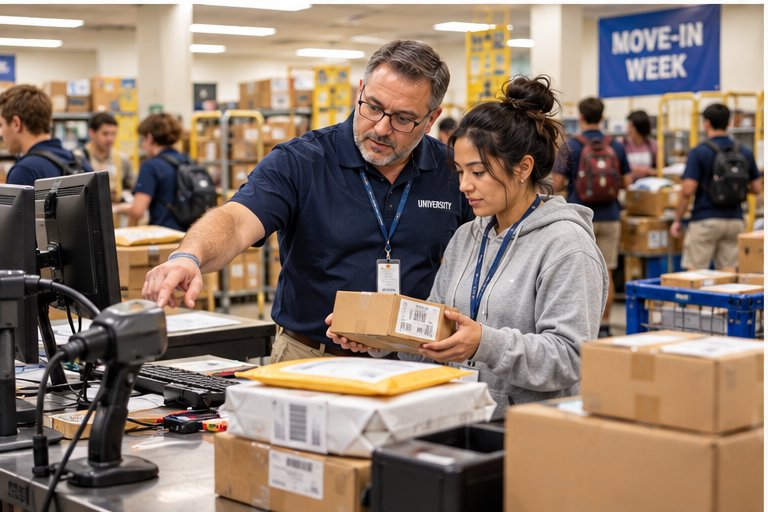
Package volume rarely stays flat throughout the year. Retail-adjacent office buildings, universities, and residential communities routinely see sharp increases during specific periods, the holiday shopping season, university move-in week, or a facility’s own busy season, and permanent mailroom staff alone often cannot absorb that surge without significant delays in package processing. The common solution is bringing on temporary or seasonal staff for a defined window, but this creates its own problem: temporary employees need to become productive fast, often within their first shift, because the surge they were hired to help with is already underway by the time they start.
A mailroom that relies heavily on informal knowledge, where packages get logged, how exceptions are handled, which shelf belongs to which building or department, puts a heavy burden on permanent staff to train each new temporary hire individually, which itself consumes time during the busiest period of the year when that time is least available.
How Guided Software Workflows Shorten the Learning Curve
Package tracking software designed with staff turnover in mind structures the intake and release process as a series of clear, sequential steps rather than relying on the employee to remember an entire process from memory. A new hire scans a package barcode, and the software prompts for the next required action, confirming the recipient match, selecting a storage location, or flagging an exception, rather than expecting the employee to already know the facility’s specific procedure. Because the software enforces the correct sequence, a temporary employee is far less likely to skip a step or log a package incorrectly compared to a purely manual, paper-based process learned secondhand from a rushed coworker.
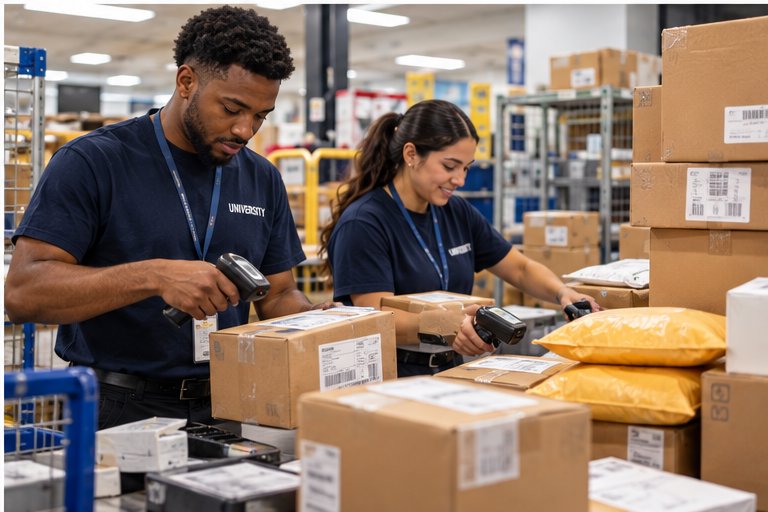
This structure also reduces the number of errors that senior staff need to catch and correct later. In a manual system, mistakes made by a new temporary hire often are not discovered until a recipient reports a missing package days later, at which point the person no longer clearly remembers the exact package or shift in question. A software-guided process creates a timestamped digital record of every action, which makes it dramatically easier to trace exactly what happened with a specific package, even when it involves a temporary employee who is no longer on-site by the time an issue surfaces.
Role-Based Access Limits Risk During High-Turnover Periods
Seasonal hiring naturally increases the number of people with some level of access to the mailroom system, which raises legitimate concerns about oversight and security during a period with less individual accountability than a stable, long-tenured staff. Package tracking software supports this by allowing role-based permissions, so temporary staff can be granted access limited to standard intake and release functions, while more sensitive actions, overriding a flagged exception, releasing a restricted item, or adjusting historical records, remain restricted to permanent staff or supervisors. This lets a facility scale up its workforce quickly without proportionally scaling up the risk of mishandled or unauthorized actions.
A Practical Example
Consider a university mailroom that brings on ten temporary staff members for the two weeks surrounding fall move-in, when package volume can run several times higher than a typical week. Without a guided software workflow, each new hire would need direct shadowing from an experienced staff member before working independently, consuming hours of permanent staff time that is in short supply during the surge itself. With a guided, scan-driven workflow, new hires can begin working independently within their first shift after a short walkthrough of the software interface, since the software itself enforces the correct process step by step rather than relying on memorized training.
Measuring the Impact of Faster Onboarding
Facilities that track onboarding time and error rates across seasonal hiring periods often find that software-guided processes produce a measurable reduction in both. Fewer misrouted packages and fewer recipient complaints during a peak period free up permanent staff to handle genuine exceptions rather than firefighting basic process errors, which compounds the benefit of the software investment specifically during the periods when mailroom operations are under the most pressure.
What to Look for When Evaluating Software for Seasonal Staffing Needs
Facilities that regularly bring on temporary staff should evaluate how intuitive a tracking platform’s intake and release workflow genuinely is for a first-time user, not just its feature list. Role-based permission controls, clear on-screen prompts, and straightforward exception-flagging are more valuable for this use case than advanced reporting features that a temporary employee will never need to touch.
Getting Started
Learn more about how package tracking software works from intake through pickup, and see how university package tracking software supports high-volume seasonal periods like move-in week. Ready to see how it could simplify your next seasonal staffing push? Schedule a demo.
