
How Hospitals Use Package Tracking Software to Protect Chain of Custody for Pharmacy and Patient Deliveries
Hospitals need package tracking software with a documented, time-stamped chain of custody because ordinary mailroom logging cannot answer the questions a clinical environment demands: who physically handled a delivery, when, and whether it reached the right department without a gap in accountability. For pharmacy shipments, lab specimens, and patient-directed deliveries, that gap is not just an inconvenience, it is a real risk to patient safety and a real compliance exposure.
Why Hospital Receiving Is Different From a Standard Office Mailroom
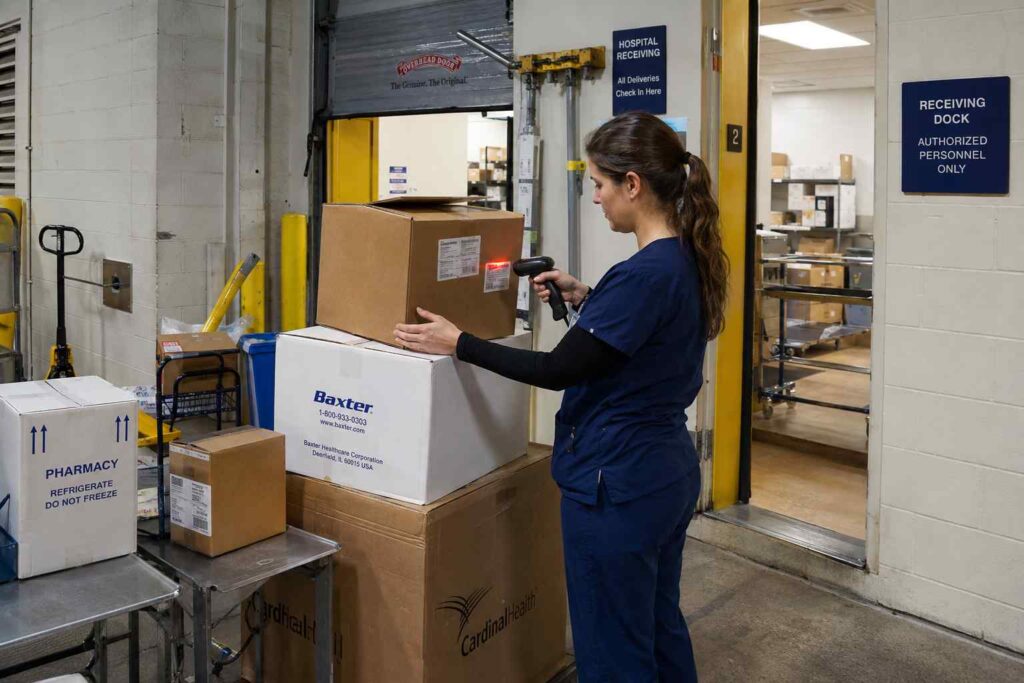
A corporate mailroom mostly deals with predictable freight: office supplies, IT equipment, the occasional personal order. A hospital receiving dock handles all of that plus a much higher stakes category of traffic moving through the same loading area every day. Pharmacy shipments, including controlled substances, arrive alongside lab specimens, blood products, medical devices, vendor equipment, and packages addressed directly to admitted patients from family members. Each of these categories can carry a different handling requirement, and they often arrive within minutes of each other at the same dock.
That mix means a hospital cannot treat receiving as a single undifferentiated intake process the way a typical office building can. A package containing a patient’s personal item and a package containing a temperature-sensitive biologic look identical from the outside, but one needs to reach a patient floor by the end of a shift and the other needs to move into cold storage within minutes of arrival. Staff have to be able to tell the difference instantly, and the system logging the delivery has to capture that distinction, not just the fact that something arrived.
What Chain of Custody Actually Requires in a Clinical Setting
Chain of custody in a hospital setting means a continuous, documented chronological history of who possessed an item at every point between arrival and final delivery, not just a record that it arrived and was eventually delivered. According to DCS Delivery, a medical logistics provider, this requires that every individual who handles a package log their interaction, with time stamps, location data, and explicit identification of the personnel involved, and that shipping labels and manifests display only the minimum information necessary for routing rather than exposing unnecessary patient or clinical detail.
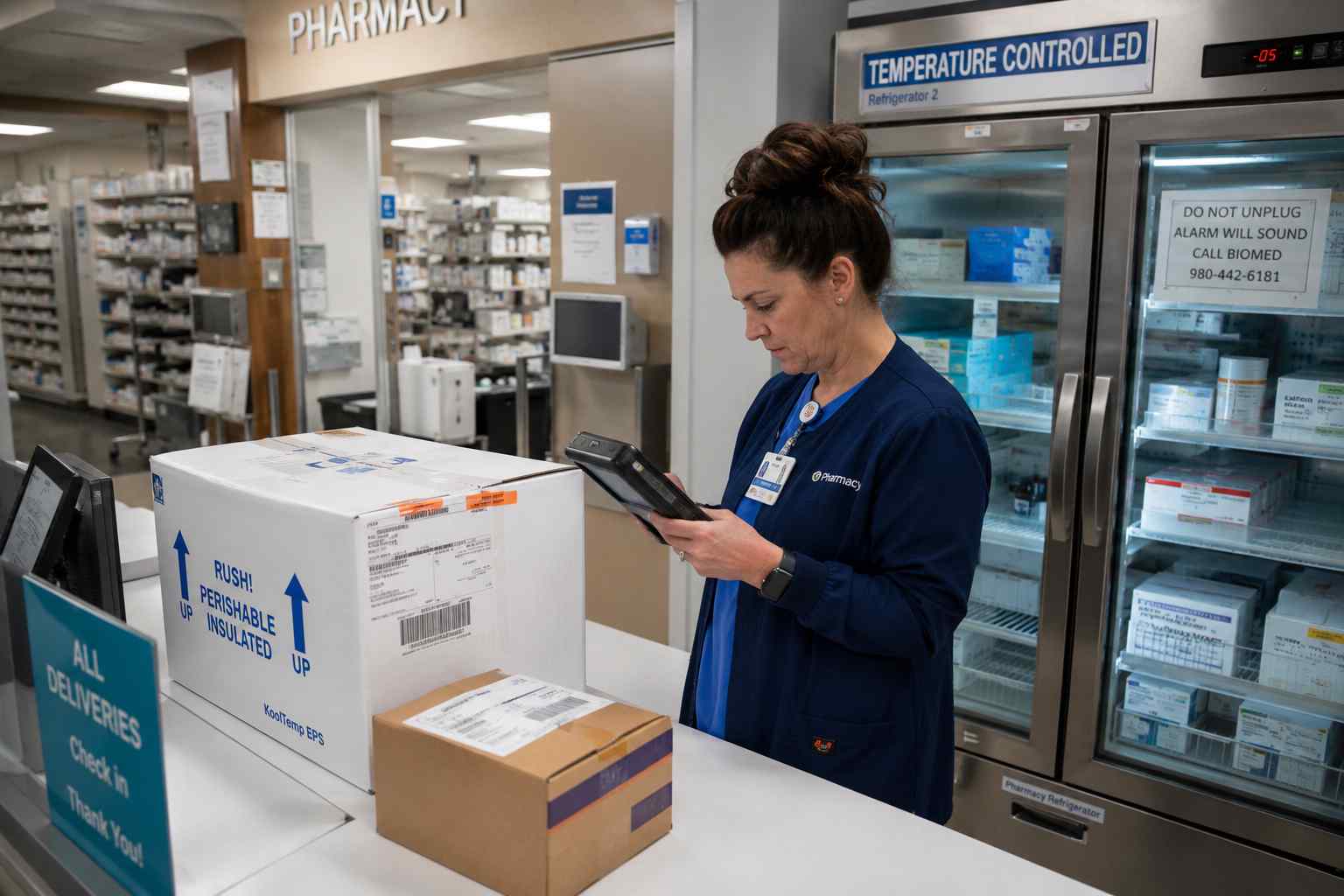
Temperature-sensitive medications add another layer. Biologics, insulin, and certain antibiotics have to maintain a specific temperature range from the moment they are received until they are placed into proper storage or handed off to a pharmacist, and a broken cold chain can mean a shipment has to be discarded even if it looks physically intact. A tracking system built for this environment has to be able to flag these shipments differently at intake and prompt staff to move them immediately, rather than letting them sit in a general queue with everything else that came off the same truck.
Controlled substances carry their own documentation burden on top of general chain of custody, since every transfer point from receiving to the pharmacy needs its own logged handoff. A hospital that cannot reconstruct exactly who held a specific package between the loading dock and the pharmacy window is exposed both operationally, if something goes missing, and administratively, if that gap ever needs to be explained during an audit.
Lab specimens raise a related but slightly different challenge. A specimen moving from a patient floor to an internal lab, or arriving from an outside reference lab, needs its own custody trail showing exactly when it left one location and arrived at the next, since a delay or mishandling can mean a test has to be redrawn, which means another needle stick for the patient and a delay in a diagnosis that may be time sensitive. Because specimens and pharmacy shipments often move through the same receiving and internal courier workflow, a tracking system that cannot distinguish between the two, or that treats every item with the same generic priority, ends up creating the exact blind spot chain of custody rules are meant to close.
Where Manual Logging Breaks Down
Paper logs and spreadsheets can technically capture a chain of custody, but they depend entirely on every staff member remembering to fill them in correctly under time pressure, during a shift where a dozen other things are also happening. A handwritten log with a skipped entry, an illegible signature, or a missing timestamp is not a minor inconvenience in this setting, it is a broken chain that cannot be reconstructed later no matter how it is investigated.
This is a widespread enough problem that it shows up clearly in industry survey data. Facility management platform FacilityOS surveyed 150 facility and mailroom operations leaders across industries including healthcare and education, and found that 42 percent named this exact category of problem as their top daily pressure point, split between 24 percent who cited managing exceptions, audits, or compliance requirements and 18 percent who specifically cited end-to-end chain of custody tracking. That is nearly half of the people running these operations naming documentation and custody tracking, not staffing or space, as the thing most likely to go wrong on a given day.
Picture a mid-size hospital receiving a routine afternoon shipment of insulin along with a stack of unrelated vendor packages. If the delivery is logged on a shared paper sheet at the dock and then walked to the pharmacy by whichever staff member happens to be free, there is no independent record of exactly when it left the dock, who carried it, or how long it sat unattended along the way. If a discrepancy is ever flagged, whether it is a missing vial or a temperature excursion, the hospital has no way to reconstruct what actually happened, only who says they remember handling it.
What to Look For in Hospital Package Tracking Software
Software built for this environment should let staff scan a package the moment it arrives and automatically create a digital record tied to that specific item, not a general daily log. A strong hospital mailroom software platform captures every subsequent handoff the same way, so the full package chain of custody exists as a searchable digital trail rather than something that has to be pieced together after the fact from memory and paper.
Automated notifications matter here too, in a different way than in a typical office. Instead of simply telling a recipient a package has arrived, package tracking notifications can be configured to alert the pharmacy the instant a temperature-sensitive shipment is scanned in, so it moves directly into proper storage instead of waiting in a general pickup queue. The same notification framework can flag lab specimens or urgent equipment differently from routine deliveries, so the right staff member is alerted immediately rather than discovering the delivery on a later walk-through.
Reporting matters as much as intake. When a compliance question or an internal investigation comes up, staff need to be able to pull a complete record for a single package in minutes, not spend an afternoon cross-referencing paper logs across multiple departments. That auditability is really the entire point of moving off paper in a clinical setting, since the value is not just faster logging, it is being able to answer a chain of custody question with certainty when it actually matters.
A Realistic Example
Consider a 300-bed hospital that receives roughly 60 to 80 packages a day across its main receiving dock, spanning pharmacy shipments, lab specimens, patient personal items, and general vendor freight. Under a paper-based process, a single missing package investigation, tracing who signed for it, who carried it, and where it was last seen, can consume a supervisor’s time for the better part of a shift, pulling from multiple logbooks and asking staff to recall a delivery from days earlier. With a scan-based system that timestamps every handoff automatically, the same investigation becomes a search by tracking number or recipient name that returns a complete custody trail in under a minute, freeing that supervisor’s time for the rest of their actual job.
The staffing math behind this shift is straightforward even at a modest scale. If a supervisor spends even two or three hours a week chasing down misplaced or disputed deliveries under a paper process, at a fully loaded cost of roughly $35 an hour for a supervisor role, that alone works out to several thousand dollars a year in time that a searchable digital custody trail would largely eliminate, before counting the cost of a genuinely lost pharmacy shipment or a specimen that has to be redrawn. That is on top of the harder to quantify risk of a compliance question the hospital cannot fully answer because the paper trail has a gap in it.
Getting Started
Hospitals evaluating a move off paper-based receiving do not need to overhaul their entire logistics operation at once. Most start by digitizing intake at the primary receiving dock and expanding department by department as staff get comfortable with the workflow. If your facility is ready to see how a scan-based chain of custody works in practice, you can schedule a demo to walk through it with a real receiving scenario.
Frequently Asked Questions
Does hospital package tracking software replace pharmacy inventory systems? No, it complements them. Tracking software manages the chain of custody from the loading dock to the point of handoff, while pharmacy inventory systems manage stock levels and dispensing once an item is inside the pharmacy.
Can the same system handle both patient personal deliveries and clinical shipments? Yes, most platforms let staff categorize packages differently at intake, so a family member’s delivery to a patient room follows a simple notification workflow while a temperature-sensitive shipment triggers an immediate alert to the correct department.
How long does it typically take staff to learn a scan-based intake process? Most facilities report staff becoming comfortable with the core scanning and handoff workflow within a single shift of hands-on use, since the process replaces a paper entry with a barcode scan rather than adding new steps.
