
How Assisted Living and Senior Living Communities Manage Resident Package Deliveries
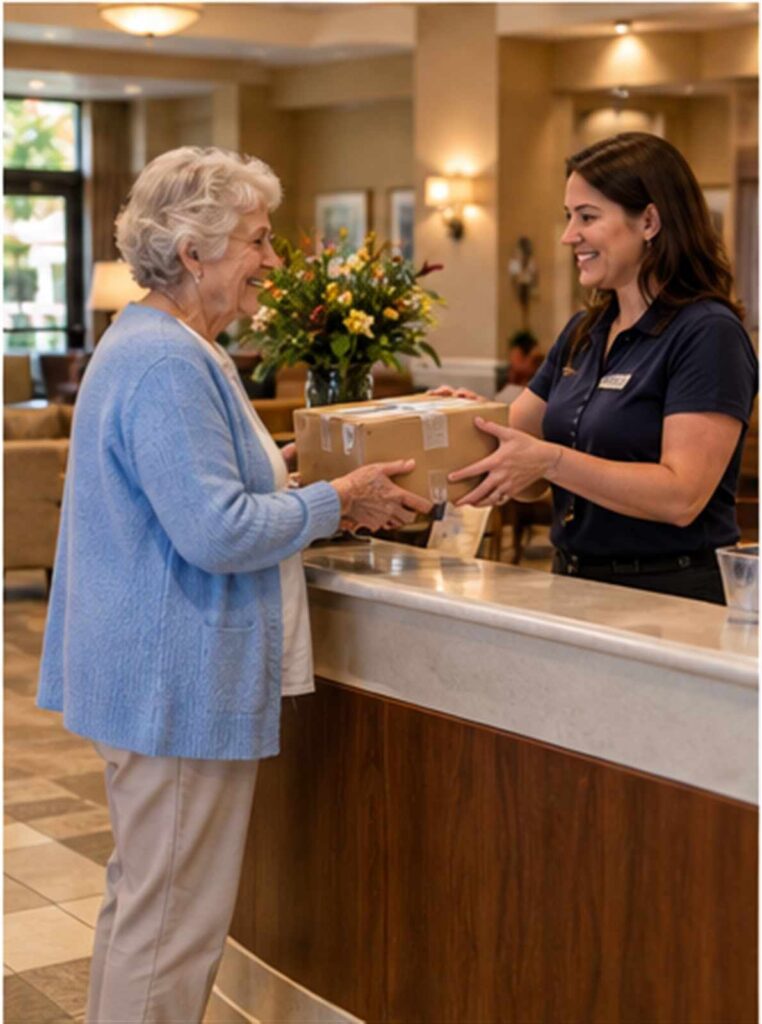
Assisted living and senior living communities manage resident package deliveries by routing everything through a front desk or concierge point that logs each item, confirms which resident it belongs to, and notifies either the resident directly or a designated staff member responsible for that resident’s daily check-ins, since many residents are not able to walk to a central mail area themselves. This is a meaningfully different problem than package handling in a typical apartment building, because the population receiving those packages often has mobility limitations, memory concerns, or family members who expect to be kept informed about deliveries on the resident’s behalf, particularly for anything medical.
A Growing Population With a Specific Set of Needs
There are approximately 41,465 assisted living communities in the United States with nearly 1.4 million licensed beds, and more than one million Americans currently reside in assisted living. Each of those communities is, functionally, running a small residential mailroom, but for a population where a missed or mishandled package carries more weight than it would for a typical apartment resident. A package containing prescription refills, medical supplies, or items a family member sent for a resident who cannot easily reorder them is not something a community can treat the way a typical residential building treats a missed Amazon order.
Staffing adds another layer of difficulty. Senior living care has one of the highest employee turnover rates of any industry in the country, and many communities are already managing tight staffing ratios focused primarily on direct resident care rather than administrative tasks like mail sorting. A package handling process that depends heavily on one specific staff member’s memory of “which resident gets deliveries left at their door versus which resident needs it hand-delivered to their room” breaks down quickly when that staff member is out sick or leaves the job, which happens often given industry turnover rates.
Why Standard Apartment-Style Package Rooms Do Not Work Well Here
A typical apartment complex can rely on a package locker wall or a self-service package room where residents pick up their own deliveries using a code sent by text. That model assumes residents can physically travel to the package room and manage a locker interface, an assumption that does not hold for a meaningful share of residents in assisted living, particularly those with mobility aids, vision limitations, or cognitive impairments that make an unfamiliar locker interface confusing rather than convenient.
Because of this, most communities need deliveries brought to the resident directly, whether that is the resident’s private room, a shared common area near their unit, or handed to a designated care staff member who will bring it during a scheduled check-in. That means the tracking and notification burden shifts from “tell the resident it arrived” to “get it into the hands of the right staff member and confirm it was actually delivered to the resident,” a meaningfully different, and more accountable, chain of custody than a typical apartment package room needs to maintain.
Keeping Family Members Informed Without Overloading Front Desk Staff
Family members of residents in assisted living are often deeply involved in day-to-day logistics, ordering supplies online, sending care packages, and coordinating medication refills through mail-order pharmacies. It is common for an adult child to call the front desk asking whether a package has arrived for a parent, especially if it contains something time-sensitive like a medication refill. Without a system that can answer that question in seconds, front desk staff end up walking to a back room to physically check a shelf or log book every time that call comes in, an interruption that adds up quickly across dozens or hundreds of residents.
A package tracking notification system that alerts a resident’s designated contact, which might be the resident themselves, a family member, or both, the moment an item is logged in removes most of that phone traffic entirely. The family member finds out their parent’s package arrived without calling, and front desk staff are not repeatedly interrupted to answer a question the system can already answer automatically.
Proof of Delivery Matters More When the Recipient Cannot Confirm It Themselves
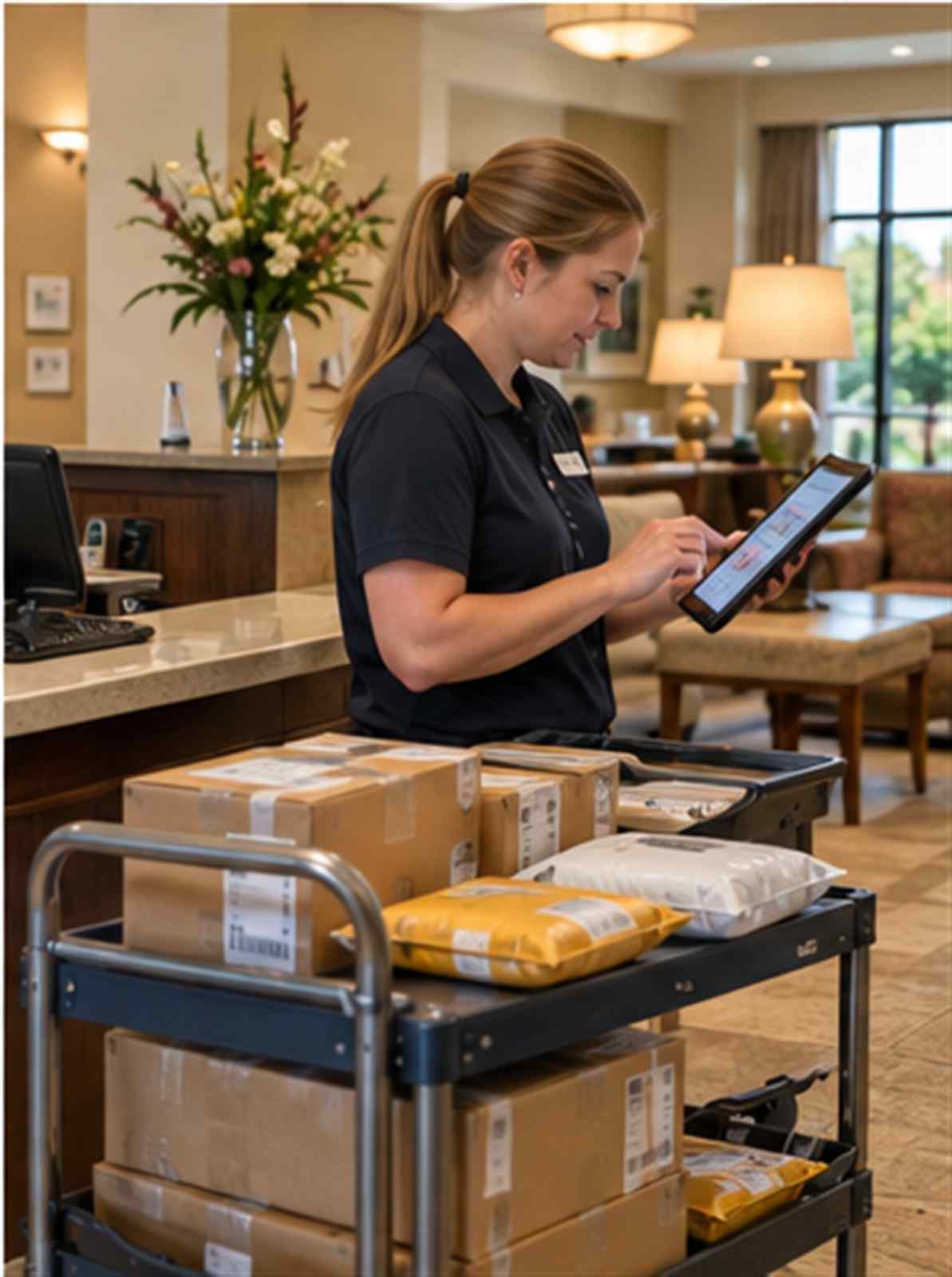
In a typical office or apartment setting, proof that a package was delivered to the right person is a convenience. In assisted living, it can be closer to a necessity, particularly for medical supplies or medication-adjacent shipments where a family member or care coordinator needs documented confirmation that an item did not just arrive at the building, but was actually placed into a specific staff member’s hands and, from there, delivered to the resident. A resident with memory-related conditions may not reliably report whether they received something, which means the community’s own proof of delivery record often becomes the only reliable account of what happened.
This is where a logged chain, scanned at intake, logged again when handed to the staff member responsible for that resident’s unit, and logged a final time when the resident or their designated caregiver confirms receipt, becomes genuinely valuable rather than just a nice-to-have feature. It gives the community a defensible answer if a family member later asks “did my mother actually receive the package I sent her,” rather than a staff member’s best recollection of a busy week.
Handling the Mix of Delivery Types Senior Communities Actually See
Package volume in senior living communities skews differently than a typical residential building. A meaningful share of deliveries are pharmacy and medical supply shipments, often arriving through specialized medical courier services rather than standard carriers, alongside the usual mix of retail orders, care packages from family, and occasional deliveries related to community-run activities and events. Treating a medical supply shipment with the same urgency and handling as a general retail package risks a delay that matters far more for a prescription refill than it would for a book order.
A system that lets front desk or concierge staff tag deliveries by type at intake, medical, general, family care package, allows a community to apply different notification urgency automatically: a medical shipment can trigger an immediate alert to both the resident’s care team and family contact, while a general retail delivery follows the standard notification flow. This kind of triage happens naturally in a well-run community already; the difference a tracking system makes is ensuring it happens consistently every time, not only when the most experienced staff member on duty happens to notice what the package contains.
Reducing the Administrative Load on Direct Care Staff
Every minute a caregiver spends manually logging a delivery, searching for a resident’s family contact information, or fielding a phone call about a missing package is a minute not spent on direct resident care, which is the actual core function these communities exist to provide. Automating the logging, notification, and lookup steps does not replace the human judgment involved in deciding how and when to bring a package to a specific resident, but it does remove the repetitive administrative overhead surrounding that decision, freeing staff time for the parts of the job that genuinely require a person.
Training Staff Without Adding to an Already Demanding Job
Given how high turnover runs in senior living care, any new process that depends on lengthy training before a new hire can use it correctly is a process that will break down regularly. The intake step for package tracking needs to be simple enough that a staff member can be shown it once, during normal onboarding, and use it correctly from their very first shift, scan the label, confirm or select the resident, choose a category if the community uses tagging, and the system handles notification and logging automatically from there. Communities that try to layer package handling on top of an already dense onboarding process, without simplifying the actual steps a new staff member has to remember, tend to see the old inconsistent habits creep back in whenever an experienced staff member is out and a newer hire is covering the desk.
It also helps to build package handling into the same daily rhythm as other resident check-ins, rather than treating it as a separate task competing for attention. A staff member who is already doing a scheduled room check for medication reminders or wellness visits can just as easily hand over a logged package during that same visit, folding delivery handling into an existing workflow instead of creating a new one that has to be remembered and prioritized on its own.
Frequently Asked Questions
- Can package tracking software notify a family member instead of, or in addition to, the resident? Yes, notification recipients can be configured per resident, so a family member, a designated care contact, or both can be alerted automatically when a package arrives, which is particularly useful for residents who are not checking email or text messages themselves.
- How does this differ from a standard apartment package room system? Standard apartment systems generally assume self-service pickup by the resident using a locker code. Senior living communities typically need staff-assisted delivery to the resident directly, so the system needs to support a documented handoff chain rather than just a pickup confirmation.
- Can medical or pharmacy deliveries be flagged for faster handling? Yes, tagging deliveries by category at intake lets a community apply different urgency rules automatically, so medical and pharmacy shipments can trigger an immediate alert rather than sitting in the same queue as general retail packages.
- Does this require residents to use any technology themselves? No, the tracking and notification work entirely on the staff and family-contact side. Residents are not required to interact with any app, locker, or interface themselves.
If your community is looking for a more reliable way to track deliveries and keep families informed without adding to direct care staff’s workload, TekCore’s start a trial page is a good place to see the system in action.
