
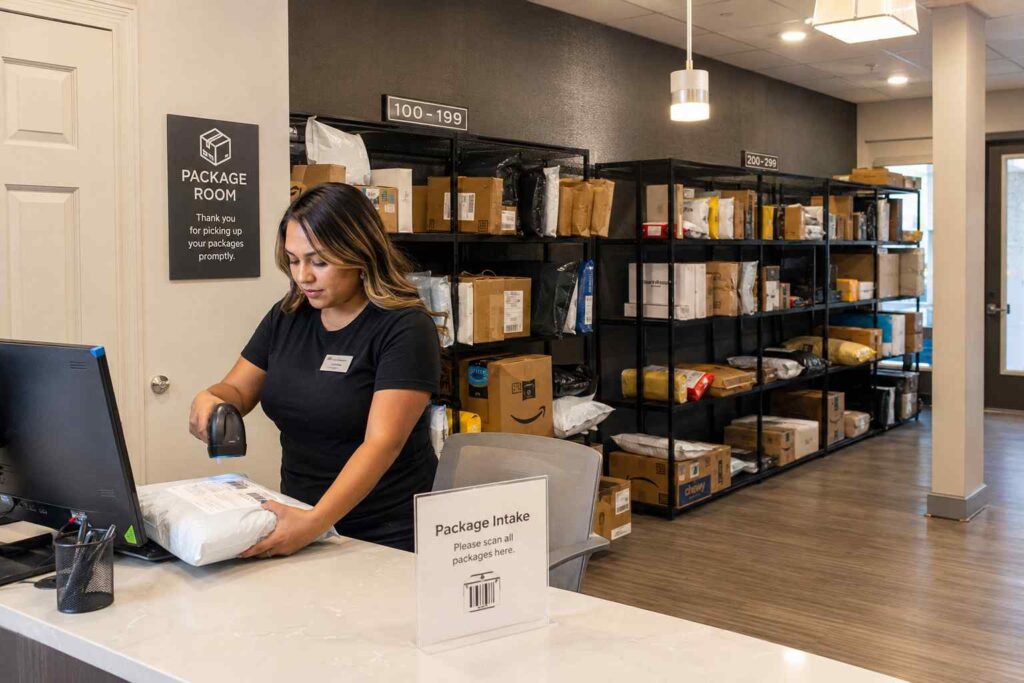
How to Choose Package Tracking Software for Apartment and Condo Communities
Choosing package tracking software for an apartment or condo community means looking beyond a basic sign-in sheet or a spreadsheet at the leasing desk, and evaluating a system built specifically for high package volume, resident self-service pickup, and clear proof of custody from the moment a carrier drops a box off to the moment a resident collects it. The right system reduces theft and misdelivery, cuts staff time spent chasing down packages, and directly affects how residents rate their living experience, which increasingly shows up in renewal decisions.
Why Package Volume Has Outgrown the Front Desk
Multifamily package volume has grown well past what a front desk team or a leasing office was ever designed to handle. A single mid-size community can easily receive several hundred packages a week, and during peak shopping periods that volume can double or triple for a short stretch. Staff who are also handling leasing calls, maintenance requests, and resident visits at the same counter simply cannot log, sort, and hand off that volume reliably using a paper log or a general-purpose spreadsheet, and every manual step, writing down a tracking number, searching a stack of boxes, calling or emailing a resident, adds time that compounds across hundreds of packages a week.
This is the operational reality that makes purpose-built package tracking software worth evaluating in the first place. It is not primarily a security purchase, it is an efficiency purchase that happens to also solve a security and liability problem along the way.
The Real Cost of Package Theft and Misdelivery in Multifamily Communities
Package theft is a genuinely larger problem for apartment and condo communities than for single-family homes. According to Capital One Shopping’s 2025 package theft research, apartment residents are three times as likely to have a package stolen than people who live in houses, and nationally, package thefts totaled 104 million incidents in 2025, costing consumers roughly $15 billion. The average stolen package was worth $144.23, and 41.8 million Americans, about 31 percent of the population, were victims of package theft over a recent 12 month period.
For a property manager, that risk is not abstract. A community that gets a reputation among residents, or worse, among prospective residents reading online reviews, for packages regularly going missing faces a real cost in complaints, staff time spent investigating claims, and in some cases genuine legal exposure. Property managers are generally not liable simply because a theft occurred, liability tends to turn on negligence, such as advertising a secure package room or lockers in a lease and then failing to install or maintain them, or ignoring repeated theft reports without acting. A documented chain of custody, timestamped intake, resident notification, and proof of pickup, is exactly the kind of record that protects a property both operationally and legally when a dispute does come up.
Why This Is a Resident Satisfaction and Retention Issue, Not Just a Security One
Package handling has become a meaningful part of how residents judge day-to-day life at a property, on the same level as maintenance responsiveness. Resident satisfaction research consistently finds that responsiveness, communication, and service delivery quality, categories a smooth package pickup experience falls squarely into, are strong predictors of overall satisfaction and renewal intent. A resident who gets a same-minute notification when a package arrives and can retrieve it without waiting on office hours has a measurably different day-to-day experience than one who has to guess whether their package made it to the leasing office at all.
Consider a 250-unit community that switched from a sign-in binder to automated tracking with resident text and email notifications. Before the change, the office fielded an average of 15 to 20 “where is my package” calls and walk-ins a week, each taking staff several minutes to resolve. After the switch, that volume dropped to a handful a week, since most residents could see their own package status without asking, freeing staff time for leasing and maintenance work that more directly affects revenue.
What to Look for in Package Tracking Software for Apartment Communities
Not every package tracking system built for a corporate mailroom translates cleanly to a residential setting, where residents, not employees, are the ones picking packages up, often outside office hours. A handful of features matter most for this specific use case.
- Resident self-service pickup. Residents should be able to see their own package status and retrieve items without needing staff present for every handoff, particularly for communities with a package room or locker bank.
- Automatic resident notifications. Text and email alerts the moment a package is logged remove the single biggest source of “where is my package” traffic at the front desk.
- Photo or signature proof at both intake and pickup. Documentation at intake protects the property if a package is later reported missing, and documentation at pickup protects against disputes over whether a resident actually received it.
- Support for high daily volume without added labor. The system should make logging a package faster than handwriting it, typically through barcode scanning, not slower, since staff time during a delivery rush is the actual bottleneck.
- Reporting for management and ownership. Ownership groups and regional managers often want visibility into package volume and aging inventory across a portfolio, not just a single property.
- Fit with existing property systems. A system that can share resident and unit data with the property’s existing management software avoids the extra step of maintaining two separate resident lists that can drift out of sync over time.
Fitting Package Tracking Into Systems You Already Run
Most communities already run a property management platform for leasing, rent collection, and maintenance requests, and many also run a separate access control or intercom system at building entries. A package tracking system that operates as a completely disconnected island creates duplicate data entry, since staff end up maintaining resident names and unit numbers in two or three places instead of one, and any of them can quietly fall out of date after a move-in or move-out. When evaluating a system, it is worth asking specifically how resident and unit information gets kept current, whether through a direct data feed, a shared import process, or manual entry, since that answer has more day-to-day impact on data accuracy than almost any other feature on the list.
This matters more at scale than it might seem from a single property’s point of view. A regional operator running a dozen communities does not want twelve different package logs with twelve different naming conventions, twelve different exception processes for handling an oversized delivery, or twelve different answers to a resident who moves between properties within the same portfolio. Consistency across properties, not just capability within one, is often the deciding factor once an operator moves past evaluating a single site and starts thinking about a standard to roll out portfolio-wide.
Liability, Documentation, and Protecting Your Property
Beyond day-to-day convenience, the documentation a good tracking system produces is what actually protects a property when something does go wrong. A timestamped log showing exactly when a package arrived, who logged it, when the resident was notified, and when and how it was picked up, turns a “he said, she said” dispute into a clear record. This matters most in the, hopefully rare, case where a resident claims a package was never received but the log shows it was logged, the resident was notified, and it was signed for at pickup. That kind of record is difficult to produce reliably from a paper sign-in sheet, and it is one of the clearest, most concrete returns a property gets from investing in dedicated software rather than a manual process.
A Realistic Example
Take a 400-unit garden-style community receiving an average of 450 packages a week, rising to over 900 during the November and December peak. Before adopting dedicated tracking software, the leasing office logged packages by hand in a three-ring binder and called or emailed residents individually when a package arrived, a process that consumed roughly 12 to 15 hours of staff time a week even in a normal month, and considerably more during peak season, on top of periodic disputes over missing packages that took additional hours each to investigate. After implementing barcode-based intake with automatic resident notifications and a self-service pickup log, intake time per package dropped from roughly two minutes to under thirty seconds, resident-initiated “where is my package” contact dropped by more than half, and the property had a clear, exportable record to point to the one time a resident disputed a pickup, resolving what would previously have been an unprovable claim in minutes.
Getting Started
For a property already juggling leasing, maintenance, and resident communication out of one office, purpose-built package tracking software for residential properties is generally a faster and more defensible path than trying to stretch a general mailroom tool, or a paper process, to fit resident-facing pickup. Systems designed around fast package receiving software workflows for high daily volume, paired with the kind of documented, portfolio-level reporting covered in TekCore’s industry benefits overview, tend to pay for themselves in recovered staff time within the first few months, well before accounting for the harder-to-quantify benefit of fewer theft disputes and happier residents at renewal time.
If your community is currently relying on a sign-in sheet or a general spreadsheet, requesting a quote is a reasonable next step to see what a purpose-built system would look like for your specific unit count and package volume.
